PocketApp
Six years of building and shipping quality products to over 2.5 Million users. A closer look at the fintech startup product I co-founded. We scaled from zero to 2 Million users in less than two years by creating amazing products that users loved and exceptional customer experiences.
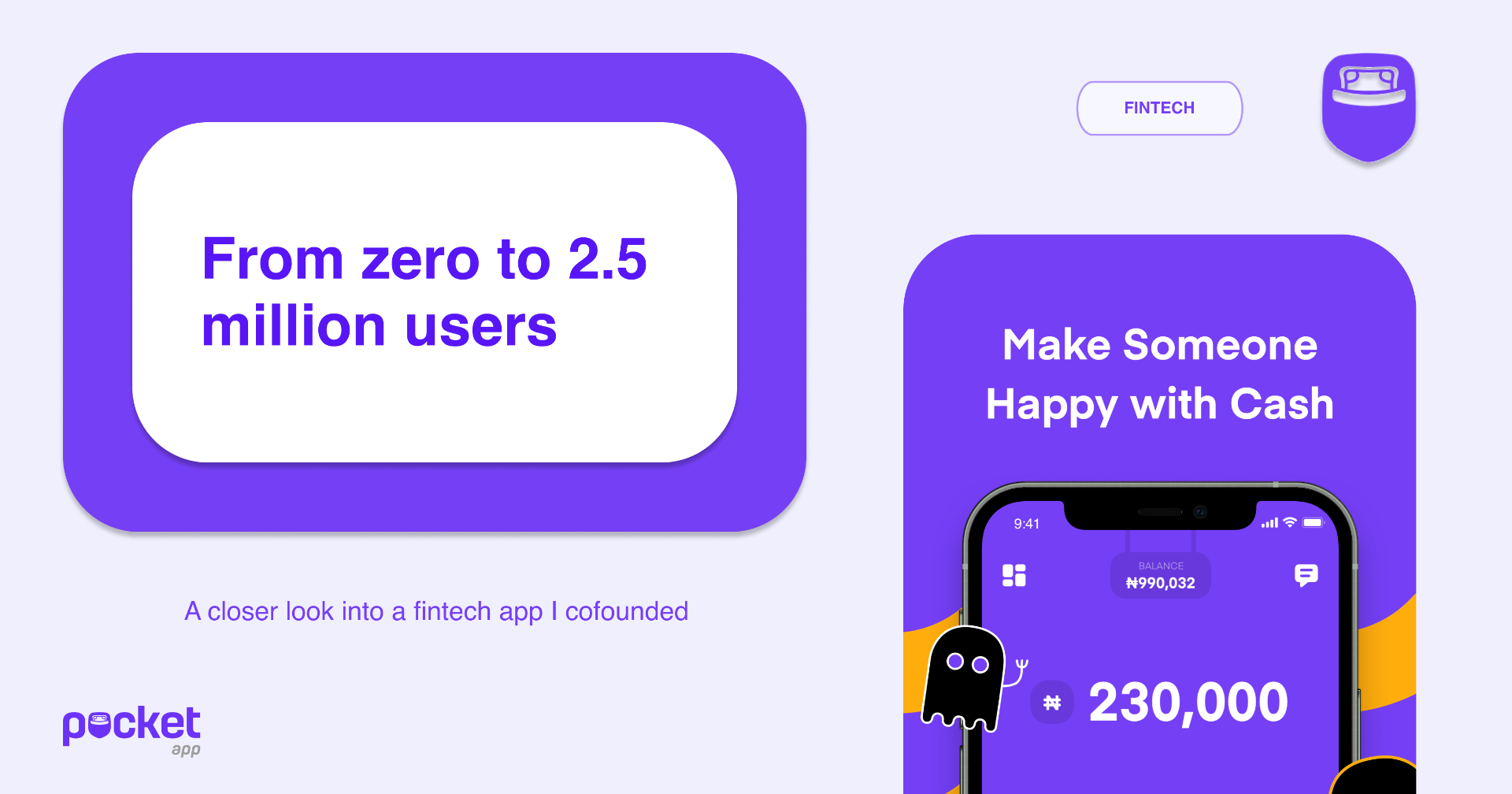
From social payments idea to 2M+ users
PocketApp (formerly AbegApp) started as a social payments platform and grew into one of Nigeria's leading B2C financial services apps. We created it to introduce a more social and engaging approach to fintech.
I was among the co-founders of the start-up and led product across the entire lifecycle: from our first user, through the acquisition, through scaling past two million users. Along the way I solo-ed customer success initially until after the acquisition, then grew the team and led over 15 specialists. I owned quality across every release for six years. Following the acquisition, I stayed on to support the transition and continued leading product efforts across iOS, Android, and web dashboards, ensuring we consistently shipped scalable experiences that solved real customer needs.
We had over 5,000 downloads in the first 2 weeks of launch with zero marketing spend, attributable mostly to our down-to-earth, fun designs and the content I created. I also led cross-functional teams across engineering, design, marketing, QA, customer success, and growth, driving product strategy, execution, quality and scale across the business.
The market and the product
The market
The Nigerian fintech market in 2018/2019 was crowded with apps that all felt the same: clinical interfaces, slow KYC, terrible customer support, with customer issues that disappeared into the void, and lots of brands building products that didn't factor in what users actually wanted. Users tolerated these brands because there weren't a lot of better alternatives; but they didn't particularly love them.
Our challenge wasn't building another wallet. It was building one that people love and could trust. We were able to achieve this through clear, engaging interfaces, a human, relatable brand, and a support function that treated complaints as product signals rather than tickets to close.
The product
The product was growing quickly because we shipped fast, but the downside of that speed was increasing product instability. Almost every release introduced new defects. Some were caught internally; others surfaced through customer support after release. Engineering moved quickly to implement fixes, but those fixes occasionally introduced new issues elsewhere, sometimes creating a cycle of reactive patching.
Support volume rose, onboarding drop-off remained high, user-reported bugs began eroding trust, and App Store ratings started to decline. There was no structured QA process in place to support the pace of releases. We were also navigating new CBN circulars and compliance requirements on extremely tight timelines.
How do we maintain the speed that fuels growth while making the product significantly more reliable and rebuilding user trust?
Four things, done well
-
0 1
Trust
A reliable platform to make transfers, instant reversals, and a support team that responded like humans, not robots reading off scripts. Users would tolerate one failure if the recovery felt personal.
-
0 2
Speed
A KYC process that takes minutes to complete, not days. A personalised, reactive P2P payment flow that didn't feel like filling out a form or answering questionnaires.
-
0 3
A relatable brand that felt like theirs
A down-to-earth, fun, and culturally specific brand. Most of our early growth came from users sharing our content on their own accounts because it sounded like them. They loved using our badges and IG filter.
-
0 4
Money tools that worked together
Group savings, contributions, and bill payments in one place, with clear status, failure states, and recovery paths. The boring details, done well.
Six moves that shaped the work
-
0 1
Brand-led growth with zero marketing spend
Our launch hit 5,000 downloads in the first two weeks with no marketing budget. This was attributed mostly to our down-to-earth, fun design and content. The product voice was the acquisition channel.
-
0 2
Quality as a product responsibility, not just an engineering one
The default position in most teams was that quality was engineering's problem, something that happened the last day before release. As PM, I put quality into everything: structured UAT every sprint, personal sign-off on releases. Engineers stopped feeling like the bottleneck and we evolved into a shared, visible process.
-
0 3
Onboarding redesign
I led the redesign of onboarding and validated it through multiple rounds of cross-device testing, confirming UX improvements and running regression checks across all affected flows. I only signed off once defined quality standards and user satisfaction criteria were met. Onboarding satisfaction increased by 15%.
-
0 4
From solo customer success to 15+ team
I built and scaled customer success before the acquisition, ensuring every ticket, escalation and angry DM was answered and resolved. After the acquisition I scaled the function to 15+ specialists and designed the workflows, escalation frameworks, and KPIs that kept quality intact at scale.
-
0 5
Cross-platform QA discipline
I designed and ran cross-platform test suites for iOS, Android, and web dashboards, maintaining separate test matrices per platform and catching defects that passed on one OS and failed on another. Over six months we cut user-reported bugs by 30%.
-
0 6
Retention via customer success
I treated a 15+ CS team as a live quality signal. Every user-reported bug was categorised by type and severity, escalated with reproduction context, and tracked to resolution. Retention went up 25%.
Two things, with hindsight
-
0 1
Document the system more formally and publicly
Much of our operational knowledge lived in Notion and team habits. While effective internally, it wasn't easily transferable. We later introduced a more structured playbook, I would have started with that approach from the beginning to improve continuity and knowledge transfer.
-
0 2
Invest in process automation earlier
Tooling has improved significantly since 2019, and the cost benefit of automating critical workflows is now much clearer. Introducing automation earlier would have reduced manual overhead and enabled the team to ship faster with greater confidence.
Five lessons from six years
-
0 1
Six years in a startup taught me what you don't see when you ship across multiple environments quickly. The highest leverage thing a lead PM can do is build a quality culture into a team early, before they need it. Once gaps appear at scale, they're harder to correct.
-
0 2
Customer support is real-time product feedback. If your CS team isn't structured to capture user pain points with proper reproduction context and severity, the team loses one of the most valuable signals in the entire product loop.
-
0 3
Brand voice can be an acquisition channel, tone and product personality are often underestimated. Having 5,000 downloads in two weeks with zero spend wasn't luck, it reflected a product experience that felt native and owned by its users. I now treat product voice work as a growth lever, not a marketing afterthought.
-
0 4
iOS and Android are not interchangeable and shouldn't be treated as 'roughly the same.' Every flow needs its own test matrix to prevent platform-specific defects from slipping through unnoticed.
-
0 5
Quality is a culture, not a phase. Every release should have explicit, agreed-upon criteria for success. Without this, 'done' becomes subjective.
Eniola is an exceptional leader with a great eye for both product, design, and engineering details. Her ability to identify gaps, improve experiences, and think deeply about product and design consistently elevated the quality of the product. The product is significantly better because of the impact and care she brought to the team throughout the journey.
From creating relatable, engaging content for users to leading product and customer success, she brought clarity and structure to every part of the experience. Enny transformed customer success into one of our strongest product feedback loops, we shipped better products because of how intentionally she connected customer insights back to the team.